Speak of the Devil: Spooky Idioms From Around the World
By Reynald · 2026-10-19
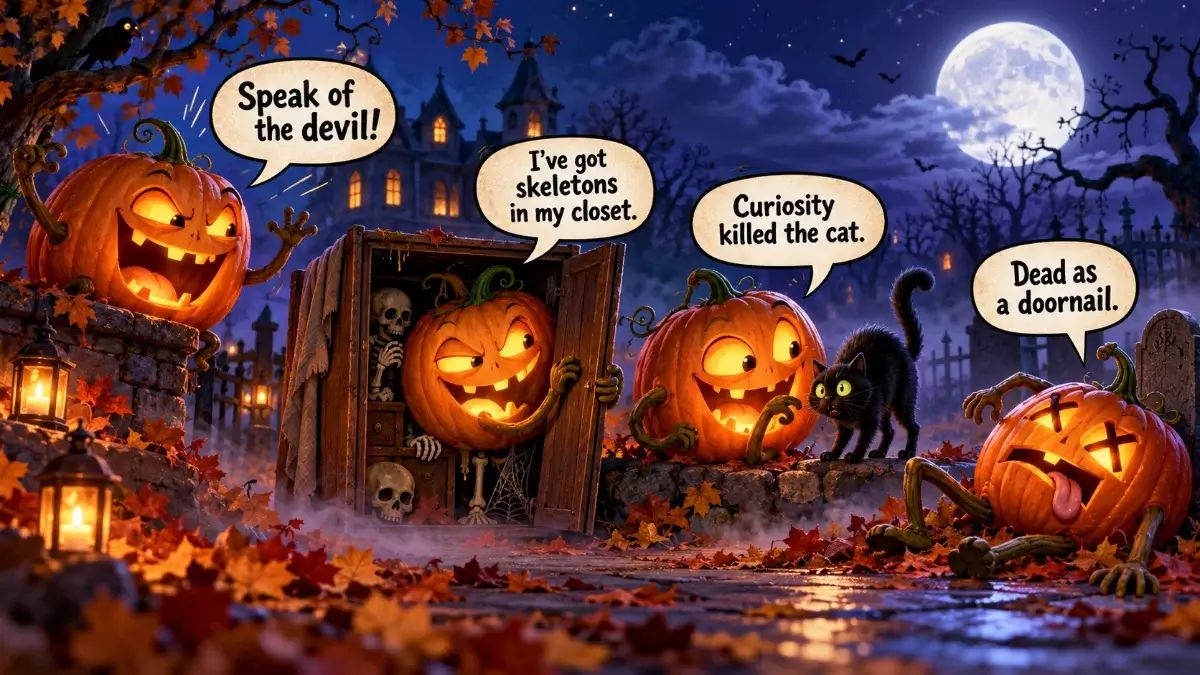
Halloween falls on a Saturday this year, and for many people it has quietly stopped being a single night. Surveys now find most Americans treat it as a whole season. Languages got there long before the candy aisles did. Every culture keeps a stock of phrases about devils, ghosts, graves and fear, and people use them all year round without noticing anything spooky about them.
We say speak of the devil when a coworker walks in. We say a printer has given up the ghost. Neither feels like a ghost story anymore, but both started as one.
Below are the best Halloween idioms we know of from around the world, grouped by the fear behind them, with the strange (and sometimes surprisingly true) stories of where they come from.
1. Speak of the devil, and he appears
The oldest fear in this list: say a dangerous thing's name and you might summon it.
| Language | Idiom | Literally |
|---|---|---|
| English | Speak of the devil | Mention the devil and he turns up |
| English (older form) | Talk of the devil and his imp appears | Even mentioning him brings his helper |
| Korean | 호랑이도 제 말 하면 온다 | "Even a tiger comes when you speak of it" |
| Lithuanian | Vilką minim, vilkas čia | "We mention the wolf, and here's the wolf" |
Today it's a joke you make when someone walks into the room. It started as a real warning. The earliest English version on record, from Giovanni Torriano's 1666 collection, runs "Talk of the Devil, and he's presently at your elbow." The idea was that naming the devil was an invitation, so you simply didn't.
What changes from country to country is the thing you're afraid of. English and German (wenn man vom Teufel spricht) picked the devil. French and Lithuanian picked the wolf: in French, quand on parle du loup, on en voit la queue, "speak of the wolf and you see its tail." Korea picked the tiger, which isn't a fairy-tale choice: tigers roamed the Korean peninsula's mountains into the 20th century, and talking about one nearby really did feel like tempting fate.
2. A skeleton in the closet
| Language | Idiom | Literally |
|---|---|---|
| English | A skeleton in the closet | A hidden skeleton |
| French | Avoir un cadavre dans le placard | "To have a corpse in the cupboard" |
Both mean a shameful secret, but French made the body considerably fresher. English keeps tidy bones; French keeps a whole corpse.
You'll often read that the phrase comes from doctors hiding illegally obtained bodies in cupboards. It makes a great story, but there's little evidence for it. The earliest known use, in an 1816 essay in a British magazine called The Eclectic Review, used the "skeleton" to stand for a hereditary illness a family preferred not to mention. The novelist William Makepeace Thackeray made the phrase popular in the 1840s and 1850s. Today Americans keep their skeletons in the closet, while the British usually keep theirs in the cupboard.
3. Giving up the ghost: idioms about death
Every language needs a way to talk about death without quite saying the word, and the results are often darkly funny.
| Language | Idiom | Literally |
|---|---|---|
| English | Give up the ghost | To let the soul go |
| German | Den Geist aufgeben | "To give up the ghost" |
| English | Push up daisies | Flowers growing from the grave |
| Polish | Wąchać kwiatki od spodu | "To sniff the flowers from below" |
| French | Sentir le sapin | "To smell of fir" |
| English | Kick the bucket | — |
| English | Sleep with the fishes | — |
| English | Dead as a doornail | As dead as the nail in a door |
| English | Curiosity killed the cat | — |
Give up the ghost is one of the oldest of these. In older English, ghost meant the soul or spirit (the same sense survives in "Holy Ghost"), and the King James Bible of 1611 uses the phrase again and again for dying. German says exactly the same thing. These days both languages mostly use it for machines: the car, the laptop, the washing machine.
English and Polish share the same picture, flowers on a grave, but stand in different places. English soldiers in the First World War made pushing up daisies common slang, with the dead person helping the flowers grow. Polish takes the dead person's point of view: you're down there, sniffing the flowers from below.
The French version is the most practical. Fir is a cheap wood, and for a long time it was what ordinary coffins were made of. By the late 18th century a coffin was jokingly called une redingote de sapin, "a fir overcoat." So if someone "smells of fir," they're about to be measured for one.
Dead as a doornail is even older than the King James Bible: it turns up in English poetry of the 1350s, including William Langland's Piers Plowman, and Shakespeare used it too. Its most famous appearance is the opening of Charles Dickens's A Christmas Carol (1843), where old Marley is "as dead as a door-nail" and the narrator stops to wonder what's so especially dead about a doornail. Nobody has a definitive answer. The most popular theory is that doornails were hammered through the wood and bent flat on the other side, so they could never be pulled out or used again, but that has never been proven.
Curiosity killed the cat didn't start out being about curiosity at all. The earliest version, in Ben Jonson's 1598 play Every Man in His Humour, is "care killed the cat," and care there meant worry or sorrow, so the warning was that fretting can kill even an animal with nine lives. Shakespeare used it the following year in Much Ado About Nothing. The "curiosity" version only took over in the late 1800s, and it later picked up a cheerful comeback some people still add: "…but satisfaction brought it back."
4. Scared stiff: idioms about fear
| Language | Idiom | Literally |
|---|---|---|
| English | One's blood runs cold | Blood turning cold in the veins |
| English | White as a sheet | As pale as bleached linen |
| French | Avoir la chair de poule | "To have hen's flesh" |
| French | Avoir une peur bleue | "To have a blue fear" |
| Swedish | Att vara rädd som en hare | "To be afraid like a hare" |
| Chinese | 杯弓蛇影 | "Bow in the cup, snake in the reflection" |
| Japanese | 杞憂 | "The worry of the man from Qi" |
White as a sheet is less of an exaggeration than it sounds. A sudden fright makes the body pull blood away from the skin, so a scared face really does go pale within seconds, and bleached bed linen was the whitest thing in most homes.
English gets goosebumps; French gets hen's flesh. It's the same plucked-bird skin, just a different bird. As for the French peur bleue, nobody knows for certain why fear should be blue. The best-documented theory points to the 1832 cholera epidemic in Paris, when victims' skin turned bluish and people were terrified of catching it. It's an appealing explanation, but still an unproven one.
The two East Asian idioms describe a different kind of fear: the kind you invent yourself. The Chinese one comes with a ghost story that turns out not to be one. In a version written down around the 2nd century AD, a guest at a dinner sees a small snake in his wine cup, drinks anyway out of politeness, and goes home sick with dread. When the host later seats him in the same spot, he realizes the "snake" was just the reflection of a red crossbow hanging on the wall, and he recovers on the spot. Japanese borrowed its idiom from another Chinese tale: a man from the small state of Qi who couldn't eat or sleep because he was afraid the sky might fall on him.
5. The devil gets everywhere
In English idioms, the devil mostly means trouble. In other languages he stands for things you'd never guess: being broke, being furious, making a racket, running fast, or being very far away.
| Language | Idiom | Literally | Actually means |
|---|---|---|---|
| French | Tirer le diable par la queue | "To pull the devil by the tail" | To struggle to make ends meet |
| Italian | Avere un diavolo per capello | "To have a devil for every hair" | To be furious |
| Italian | Fare il diavolo a quattro | "To make the devil times four" | To raise hell |
| Portuguese | Fugir como o diabo foge da cruz | "To flee like the devil flees the cross" | To avoid something at all costs |
| Dutch | Bij de duivel te biecht gaan | "To go to confession with the devil" | To confide in the worst possible person |
| Welsh | Rhedeg fel cath i gythraul | "To run like a cat to the devil" | To run flat out |
| French | Au diable vauvert | "At the devil's Vauvert" | In the middle of nowhere |
The French one about poverty has a bleak kind of logic: when you've run out of everyone else to ask, you end up tugging at the devil's tail for help.
Fare il diavolo a quattro has a French twin, faire le diable à quatre. The usual explanation, though nobody has proven it, goes back to medieval religious plays, whose noisiest scenes needed several devils rampaging across the stage at once.
Au diable vauvert is tied to a real place. Vauvert was a royal residence on the edge of medieval Paris, roughly where the Luxembourg Gardens are now. Abandoned after the 11th century, it got a reputation for strange nighttime noises and was said to be haunted. In 1258 King Louis IX handed it over to an order of monks, the devil reportedly moved out, and the phrase survived as the French way of saying "the back of beyond."
English has its own famous devil puzzle: between the devil and the deep blue sea, meaning stuck between two bad options. It first appears in a Scottish soldier's memoir of 1637, "betwixt the devill and the deep sea." A popular theory claims "the devil" was sailors' slang for a hard-to-reach seam on a ship's hull. That's possible, but the plainer reading (damnation on one side, drowning on the other) is just as old.
6. Wishing someone luck by inviting disaster
Some of the strangest idioms on this list are actually kind wishes.
| Language | Idiom | Literally | Traditional reply |
|---|---|---|---|
| English | Break a leg | Injure yourself | Thanks! |
| Italian | In bocca al lupo | "Into the wolf's mouth" | Crepi! ("May it die!") |
| Russian | Ни пуха ни пера | "Neither fur nor feather" | К чёрту! ("To the devil!") |
All three work on the same superstition: wishing someone good luck out loud might jinx it, so you wish them something terrible instead. The Russian version comes from hunters. "Neither fur nor feather" means "may you catch nothing," and the hunter answers by sending the well-wisher (or maybe the bad luck) straight to the devil. Italians send the person into the wolf's mouth, and the polite reply wishes death on the wolf.
7. Hell as a measuring stick
Hell turns out to be very useful for measuring things: how unlikely something is, how determined you are, how fast you're going.
| Language | Idiom | Literally |
|---|---|---|
| English | When hell freezes over | Never |
| English | A snowball's chance in hell | No chance at all |
| English | Come hell or high water | No matter what |
| English | Like a bat out of hell | Extremely fast |
| French | À tombeau ouvert | "With the tomb open" (also extremely fast) |
| French | L'enfer est pavé de bonnes intentions | "Hell is paved with good intentions" |
Several of the English ones are American and surprisingly recent: a snowball's chance in hell and come hell or high water both date from the late 1800s. Like a bat out of hell shows up in the early 20th century and got a second life from Meat Loaf's 1977 album.
The two "fast" idioms show the difference in attitude. English pictures a panicked bat escaping the flames; French pictures your grave, already dug and waiting, while you drive à tombeau ouvert. It's almost always used about reckless driving.
The paving saying is the oldest of the group. It's usually traced to the 12th-century monk Bernard of Clairvaux, and Samuel Johnson was recorded using the "paved" form in 1775. English later added the road to hell.
8. The one that stopped being a joke
| Language | Idiom | Literally |
|---|---|---|
| English | A witch hunt | A hunt for witches |
| French | Une chasse aux sorcières | "A witch hunt" |
Most idioms here started out frightening and became playful. This one went the other way. The witch trials of the 16th and 17th centuries, including Salem in 1692, were real persecutions. The phrase took on its modern political meaning in 1950s America, during the anti-communist investigations, when Arthur Miller's play The Crucible (1953) used Salem to hold up a mirror to them. French borrowed the phrase whole, and it carries the same weight there.
What spooky idioms tell us
People have always been afraid of naming things. Speak of the devil, the Korean tiger and the Lithuanian wolf all share the same old rule: say its name and it might come. The hunters' luck wishes follow the same logic in reverse: don't name the good thing you want, or you'll scare it away. Many linguists think the English word bear comes from this same habit. The leading theory is that it was originally a nickname, roughly "the brown one," used so that hunters didn't have to say the animal's real name.
Fear wears local clothes. The devil in Europe, the wolf in the forests of Lithuania, the tiger in the Korean mountains, cheap fir coffins in France. Each idiom keeps a small trace of what people in one place actually lay awake worrying about.
Time takes the fear out. A phrase that once meant "don't say his name or he'll come for you" now means "oh, hi, Dave." That may be the most reassuring thing about all of these. Given enough time, even the scariest images become something we say about a broken printer.
Happy Halloween! 🎃
Keep exploring
Every idiom above has its own page with its full meaning and origin. Pick a language to dig deeper:
English idioms · French idioms · Italian idioms · German idioms · Portuguese idioms · Russian idioms · Polish idioms · Dutch idioms · Swedish idioms · Korean idioms · Chinese idioms · Japanese idioms
Or browse the full idiom collection for thousands of expressions from more than 50 languages, each with its literal translation, real meaning and origin.
Loading the full interactive collection…