ProverbHuman Nature Biblical origin
A leopard can't change its spots
Meaning: People can't fundamentally change their nature.
Where it's from: The Bible, Jeremiah 13:23
Example: “He says he's stopped gambling, but a leopard can't change its spots.”
Origin: From Jeremiah 13:23: "Can the Ethiopian change his skin, or the leopard his spots? then may ye also do good, that are accustomed to do evil." The prophet's point is that ingrained habits of wrongdoing are nearly impossible to shed.
Equivalents in French, Spanish, Japanese, German, Italian, and 6 more languages
 French: Chassez le naturel, il revient au galop (literally: Chase away nature, it comes back galloping)
 Spanish: Genio y figura hasta la sepultura (literally: Character and form until the grave)
 Japanese: 三つ子の魂百まで (Mitsugo no tamashii hyaku made) (literally: The soul of a three-year-old lasts until a hundred)
 German: Die Katze lässt das Mausen nicht (literally: The cat will not give up catching mice)
 Italian: Il lupo perde il pelo ma non il vizio (literally: The wolf loses its fur but not its vice)
 Dutch: Een vos verliest wel zijn haren, maar niet zijn streken (literally: A fox loses its hair but not its tricks)
 Russian: Горбатого могила исправит (Gorbatogo mogila ispravit) (literally: Only the grave will straighten a hunchback)
 Polish: Natura ciągnie wilka do lasu (literally: Nature pulls the wolf to the forest)
 Chinese: 江山易改,本性难移 (Jiāngshān yì gǎi, běnxìng nán yí) (literally: Rivers and mountains change easily; nature hardly)
 Arabic: الطبع يغلب التطبع (Aṭ-ṭabʿ yaghlib at-taṭabbuʿ) (literally: Nature beats nurture)
 Turkish: Huylu huyundan vazgeçmez (literally: A person of habit won't give up his habit)
On the map
What never changes?
The same idea in 23 versions, colored by the picture each one uses. Each country shows the version in its main language.
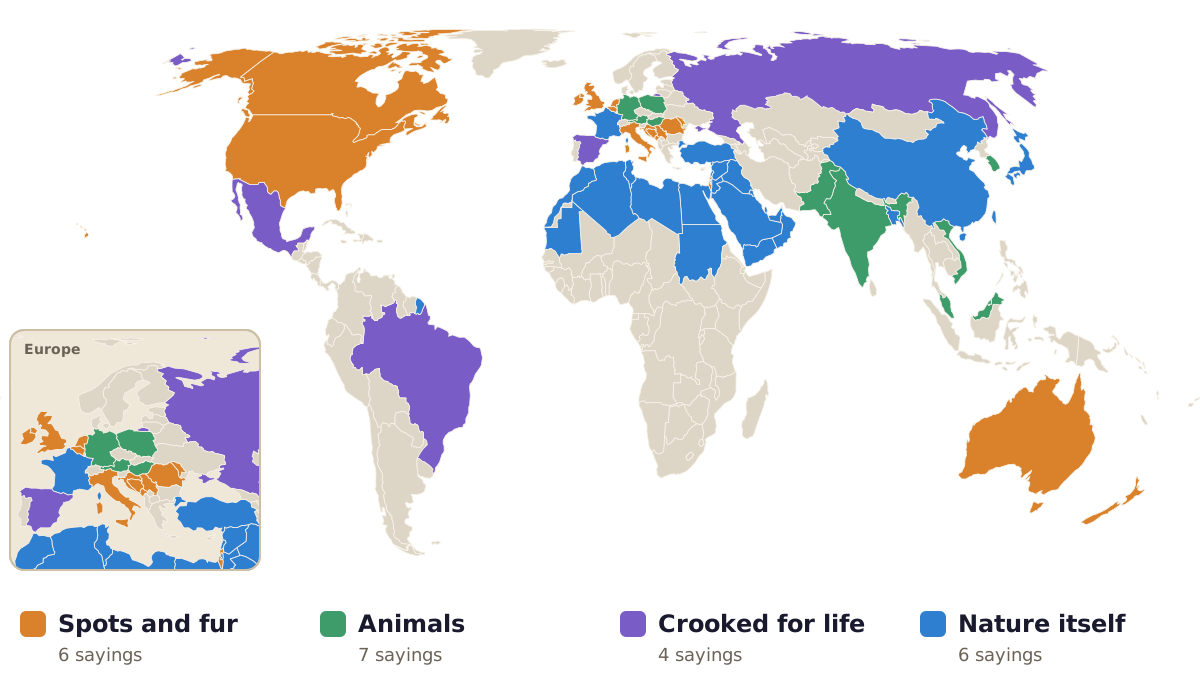
Download the full map with every saying (PNG)See all world maps
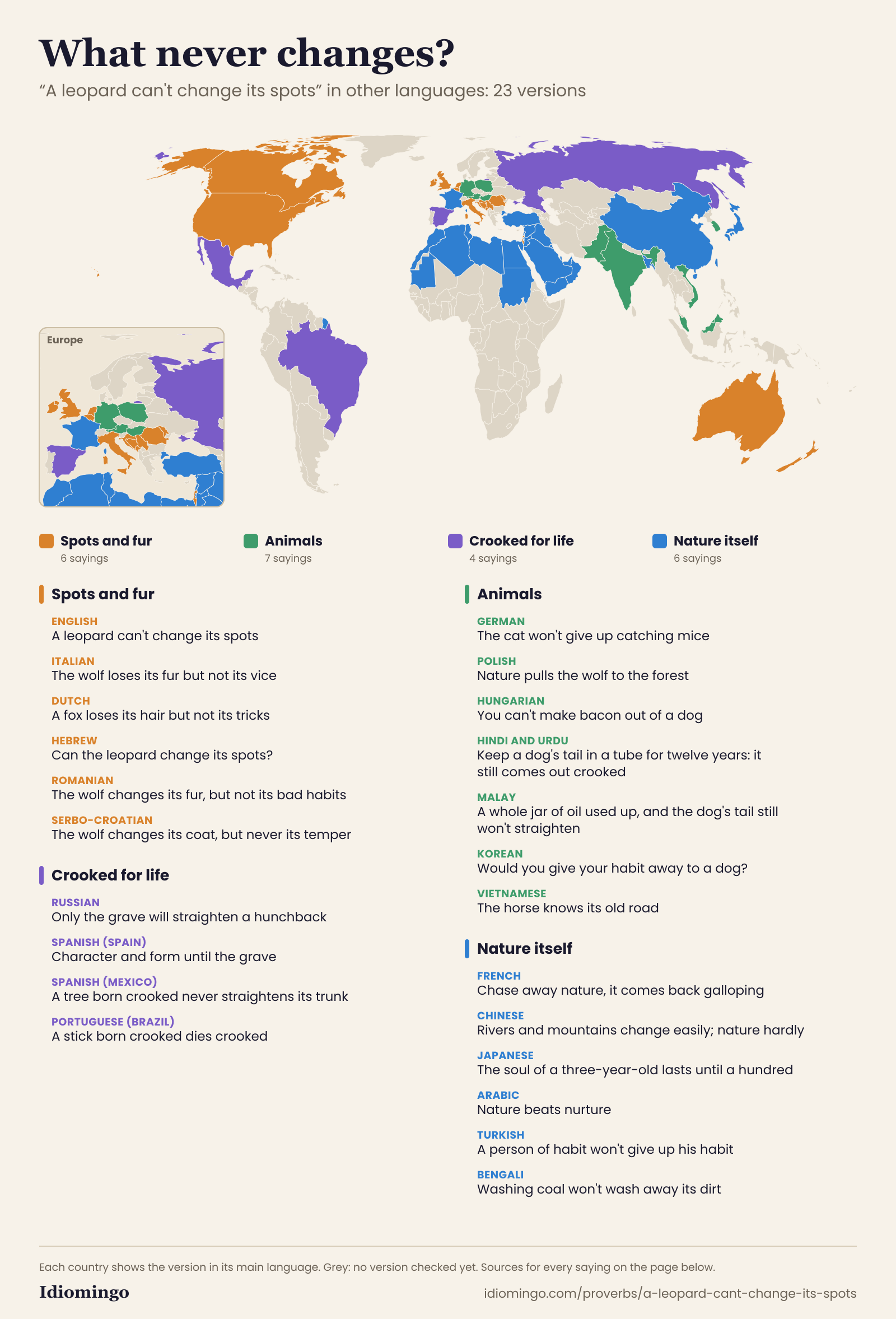
11 more languages on the map
 Hebrew (Hayahafokh … ve-namer ḥavarburotav)“Can the leopard change its spots?”Source: Jeremiah 13:23, where the English proverb comes from
 Romanian “The wolf changes its fur, but not its bad habits”Source: Dicționarul limbii române literare contemporane (1955–57) and CADE (1926–31), via dexonline
- Serbo-Croatian “The wolf changes its coat, but never its temper”Source: Wiktionary
 Hungarian “You can't make bacon out of a dog”Source: Wiktionary; Daily News Hungary
 Hindi and Urdu (Kutte kī dum bārah baras nalkī meṉ rakhī, phir bhī ṭeṛhī)“Keep a dog's tail in a tube for twelve years: it still comes out crooked”Source: Rekhta dictionary
 Malay “A whole jar of oil used up, and the dog's tail still won't straighten”Source: Dewan Bahasa dan Pustaka
 Korean (Je beoreut gae julkka)“Would you give your habit away to a dog?”Source: Wiktionary; Korean wiki entry on habits
 Vietnamese “The horse knows its old road”Source: VietJack; Viet Nam News
 Spanish (Mexico) “A tree born crooked never straightens its trunk”Source: USC Digital Folklore Archives
 Portuguese (Brazil) “A stick born crooked dies crooked”Source: Significados (Brazilian reference site)
 Bengali (Koyla dhule moyla jay na)“Washing coal won't wash away its dirt”Source: Satt Academy (Bangladesh exam reference)
Explore another collection: Idioms
Colorful expressions from dozens of languages, with their word-for-word translations.
- Avoir une peur bleue Being terrified or extremely frightened of something.
- Être du voyage To come along; to be one of those taking part in a trip or shared undertaking.
- Faire le gendarme Acting authoritarian or enforcing rules with excessive zeal.
Keep exploring