“The pot calling the kettle black”in other languages
Criticizing someone for a fault you have yourself.
 English
 Arabic
 Chinese
 Dutch
 French
 German
 Hungarian
 Italian
 Japanese
 Korean
 Polish
 Portuguese
 Russian
 Spanish
 Turkish
EnglishArabicChineseDutchFrenchGermanHungarianItalianJapaneseKoreanPolishPortugueseRussianSpanishTurkishWho calls whom black?
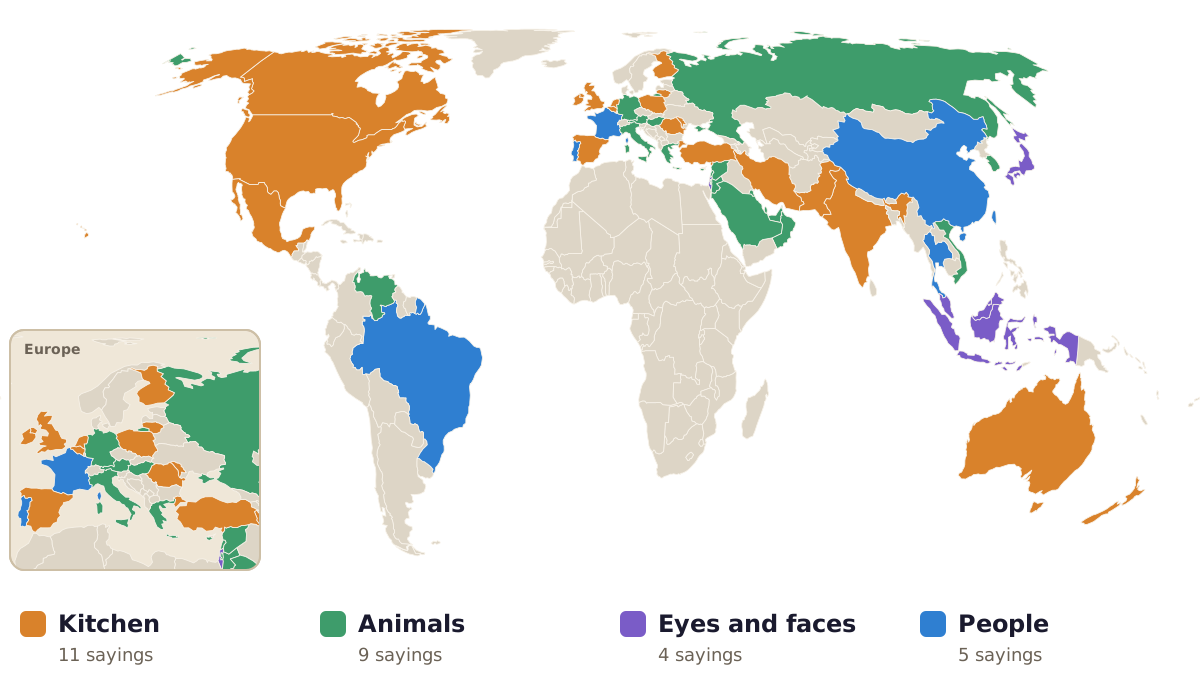
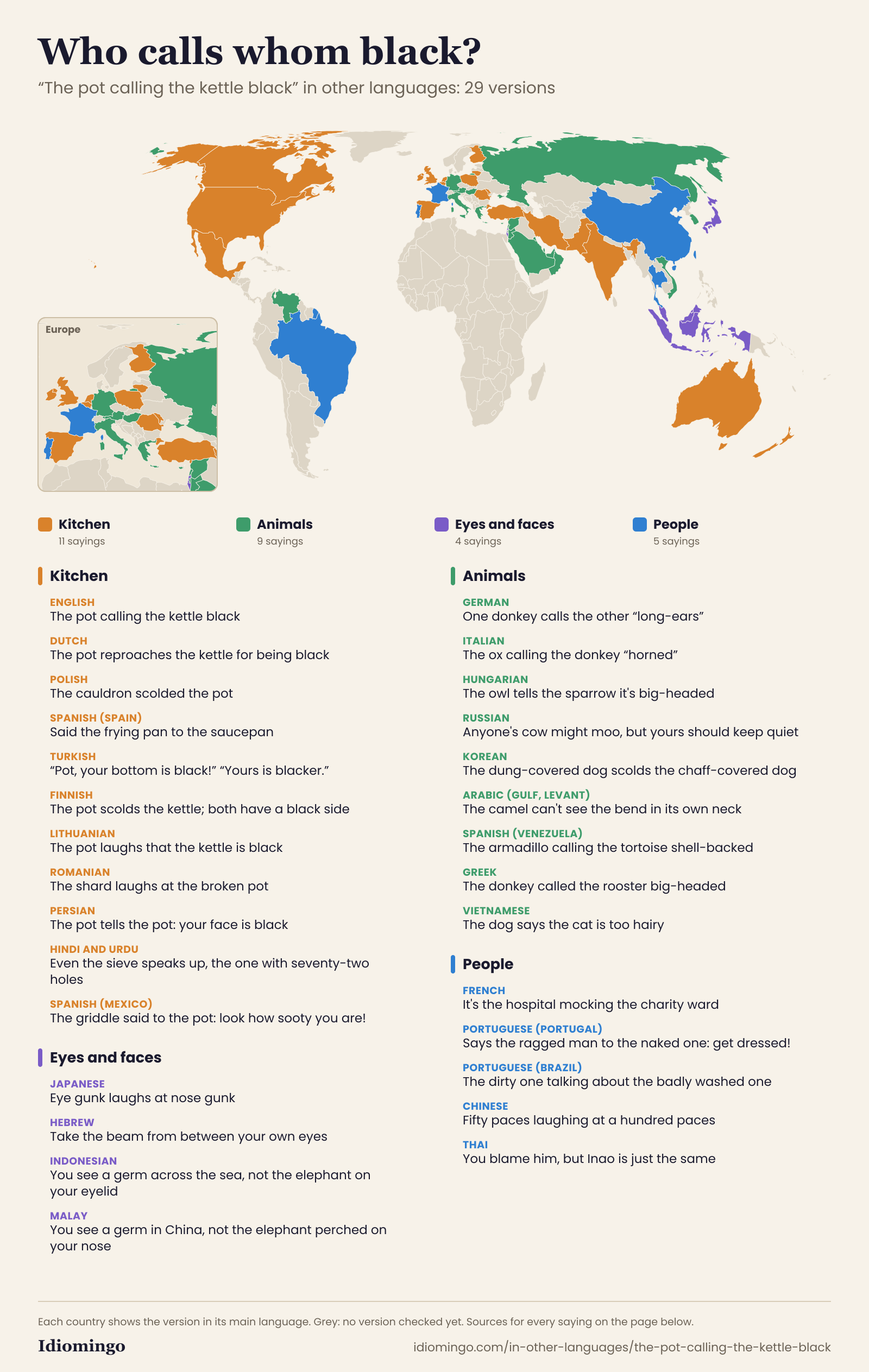
The same idea in 29 versions, colored by the picture each one uses. Each country shows the version in its main language.
Download the full map with every saying (PNG)
12 more languages on the map
- Finnish
“The pot scolds the kettle; both have a black side” Source: Wiktionary (pata) - Lithuanian
“The pot laughs that the kettle is black” Source: Kalbotyra (Vilnius University), citing the proverb collection - Romanian
“The shard laughs at the broken pot” Source: Dicționarul limbii române literare contemporane (1955–57), via dexonline - Persian (Dig be dig mige rut siyâh)
“The pot tells the pot: your face is black” Source: Wiktionary; Abadis dictionary - Hindi and Urdu (Sūp to sūp, chhalnī bhī bolī jis meṉ bahattar chhed)
“Even the sieve speaks up, the one with seventy-two holes” Source: Rekhta dictionary - Spanish (Mexico)
“The griddle said to the pot: look how sooty you are!” Source: México Desconocido - Greek (Ípe o gáidaros ton petinó kefála)
“The donkey called the rooster big-headed” Source: Academy of Athens proverb archive - Vietnamese
“The dog says the cat is too hairy” Source: VietJack - Hebrew (Tol kora mi-bein einekha)
“Take the beam from between your own eyes” Source: Talmud, Bava Batra 15b - Indonesian
“You see a germ across the sea, not the elephant on your eyelid” Source: KBBI, Indonesia's official dictionary - Malay
“You see a germ in China, not the elephant perched on your nose” Source: Dewan Bahasa dan Pustaka - Thai (Wâa tàe khǎo, Inao bpen eng)
“You blame him, but Inao is just the same” Source: Royal Institute Dictionary; the Inao epic
Same idea, different pictures
English has two blackened pans accusing each other. An early version is in a 1620 translation of Don Quixote, where Sancho's frying pan tells the pot to get away, and Spanish still says dijo la sartén al cazo, “said the frying pan to the saucepan”. Dutch, Polish and Turkish keep the sooty pots too. Portuguese has the dirty talking about the badly washed, sujo falando do mal lavado, and the man in rags asking the naked man why he doesn't get dressed.
Animals do the rest. German has one donkey calling the other long-ears, the Hungarian owl tells the sparrow it has a big head, and Venezuelan Spanish has the armadillo calling the tortoise shell-backed, cachicamo diciéndole a morrocoy conchudo. In Italian the ox, who has horns, calls the hornless donkey “horned”. Korean has a dog covered in dung scolding a dog with a bit of chaff on it, and Russian tells someone that anyone's cow may moo, but theirs should keep quiet. Arabic says the camel can't see the bend in its own neck.
Japanese makes it about the body: eye gunk laughing at nose gunk. Chinese goes back to Mencius, who asked whether soldiers who fled fifty paces could laugh at those who fled a hundred.
French has two. La paille et la poutre quotes the Gospel: the speck in your brother's eye and the beam in your own. C'est l'hôpital qui se fout de la charité is the hospital making fun of the charity ward.
More sayings in other languages
- The whole kit and caboodle
- Thick as thieves
- Throw a spanner in the works
- Throw in the towel
- Throw money down the drain
- Throw one's weight around
- Tie the knot
- Tighten one's belt
- Tilt at windmills