
ProverbHuman Nature English origin16th c.
Every man to his trade.
Meaning: Individuals excel when focusing on their own expertise rather than attempting unfamiliar work outside their competence.
Origin: Recorded from the late 16th century. Everyone should stick to what they know, an idea often linked to 1 Corinthians 7:20: "Let every man abide in the same calling wherein he was called."
Equivalents in French, Spanish, Japanese, German, Italian, and 4 more languages
 French: À chacun son métier, et les vaches seront bien gardées (literally: To each his trade, and the cows will be well kept)
 Spanish: Zapatero, a tus zapatos (literally: Shoemaker, to your shoes)
 Japanese: 餅は餅屋 (Mochi wa mochiya) (literally: For rice cakes, go to the rice-cake maker)
 German: Schuster, bleib bei deinem Leisten (literally: Cobbler, stick to your last)
 Italian: Ognuno faccia il suo mestiere (literally: Let everyone do their own trade)
 Portuguese: Cada macaco no seu galho (literally: Every monkey on its own branch)
 Dutch: Schoenmaker, blijf bij je leest (literally: Cobbler, stick to your last)
 Russian: Всяк сверчок знай свой шесток (Vsyak sverchok znay svoy shestok) (literally: Every cricket, know your own perch)
 Polish: Pilnuj, szewcze, kopyta (literally: Mind your last, cobbler)
On the map
Stick to what you know
The same idea in 16 versions, colored by the picture each one uses. Each country shows the version in its main language.
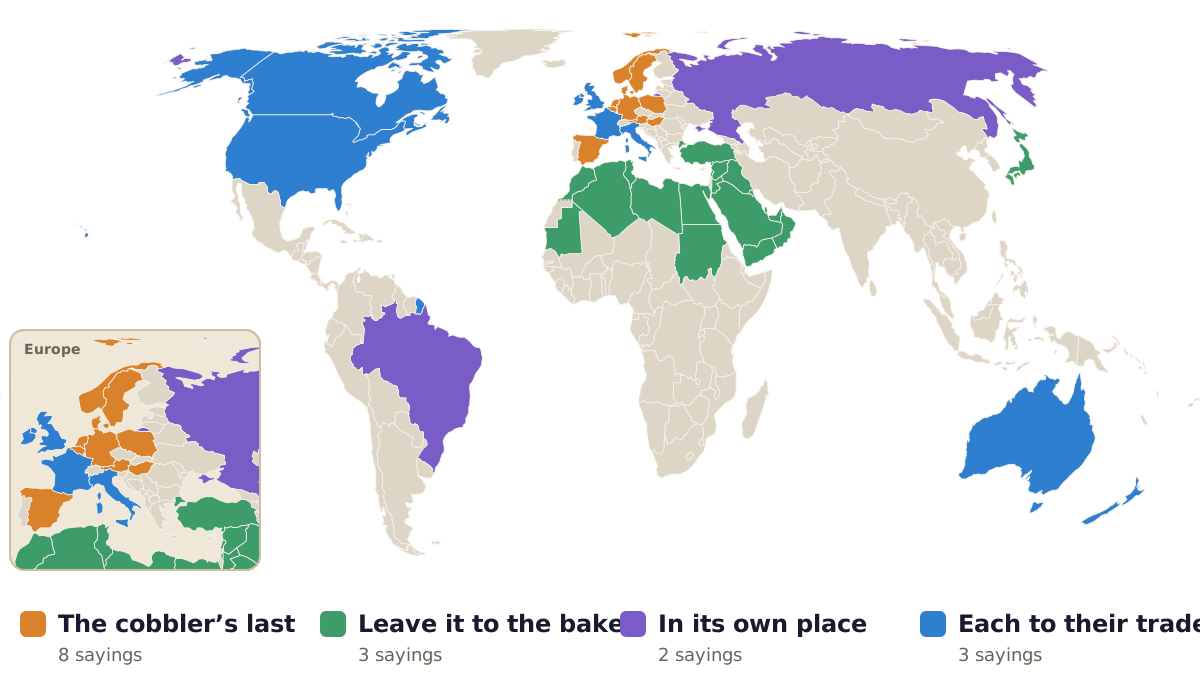
Download the full map with every saying (PNG)See all world maps
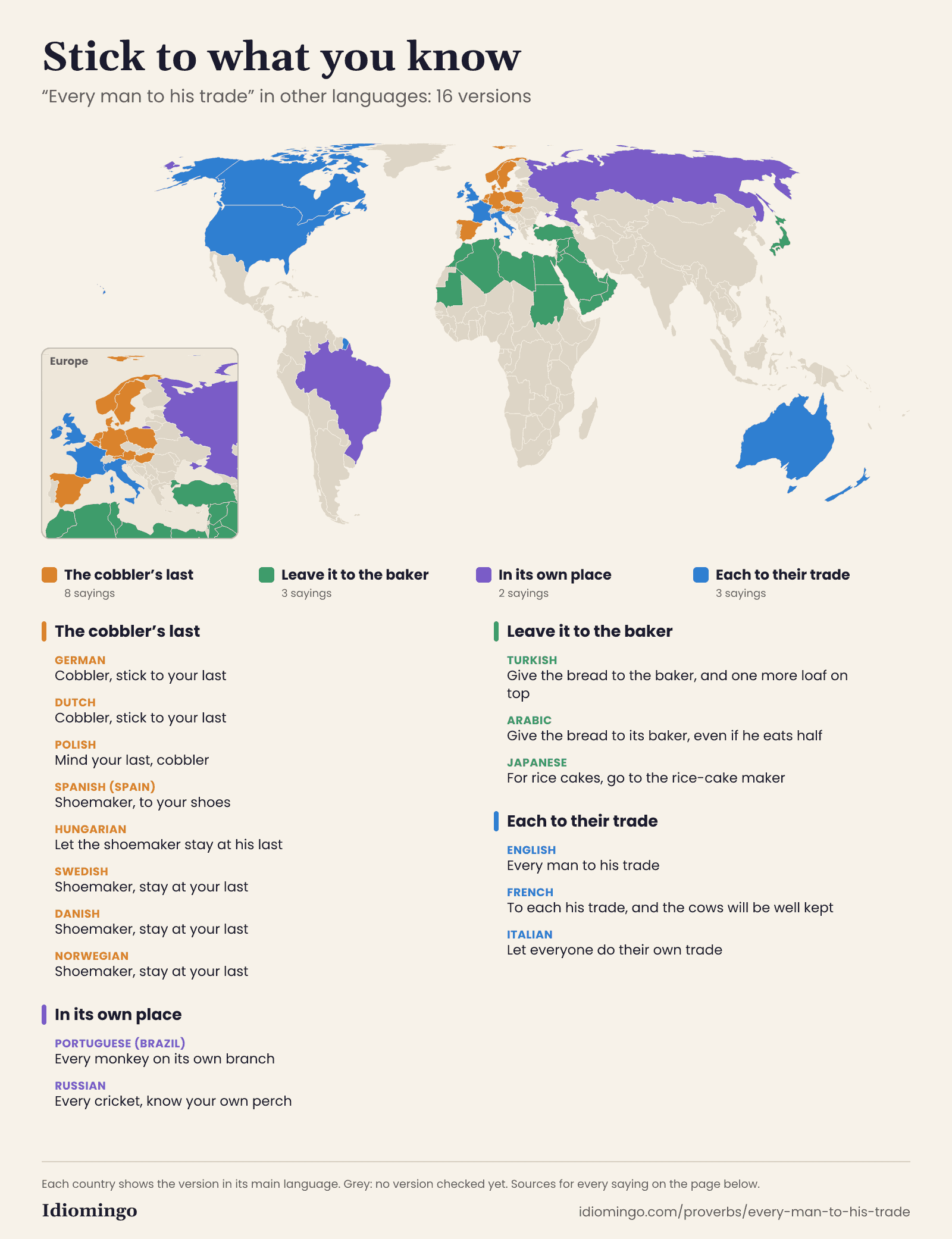
6 more languages on the map
 Hungarian “Let the shoemaker stay at his last”Source: Wiktionary; Paczolay, Hungarian proverb collection
 Swedish “Shoemaker, stay at your last”Source: Dalin's Swedish dictionary (SAOL history); Wikipedia, Ne supra crepidam
 Danish “Shoemaker, stay at your last”Source: Lex (Danish encyclopedia); Videnskab.dk
 Norwegian “Shoemaker, stay at your last”Source: Bokmålsordboka (Ordbøkene, University of Bergen); Lex
 Turkish “Give the bread to the baker, and one more loaf on top”Source: Eğitim Sistem; NTV (Turkish proverb lists)
 Arabic (Aʿṭi al-khubz li-khabbāzih wa-law akala niṣfah)“Give the bread to its baker, even if he eats half”Source: Al-Yaum (Saudi daily); Al-Kafeel forums
Explore another collection: False Friends
Words that look familiar in another language but mean something else entirely.
Keep exploring